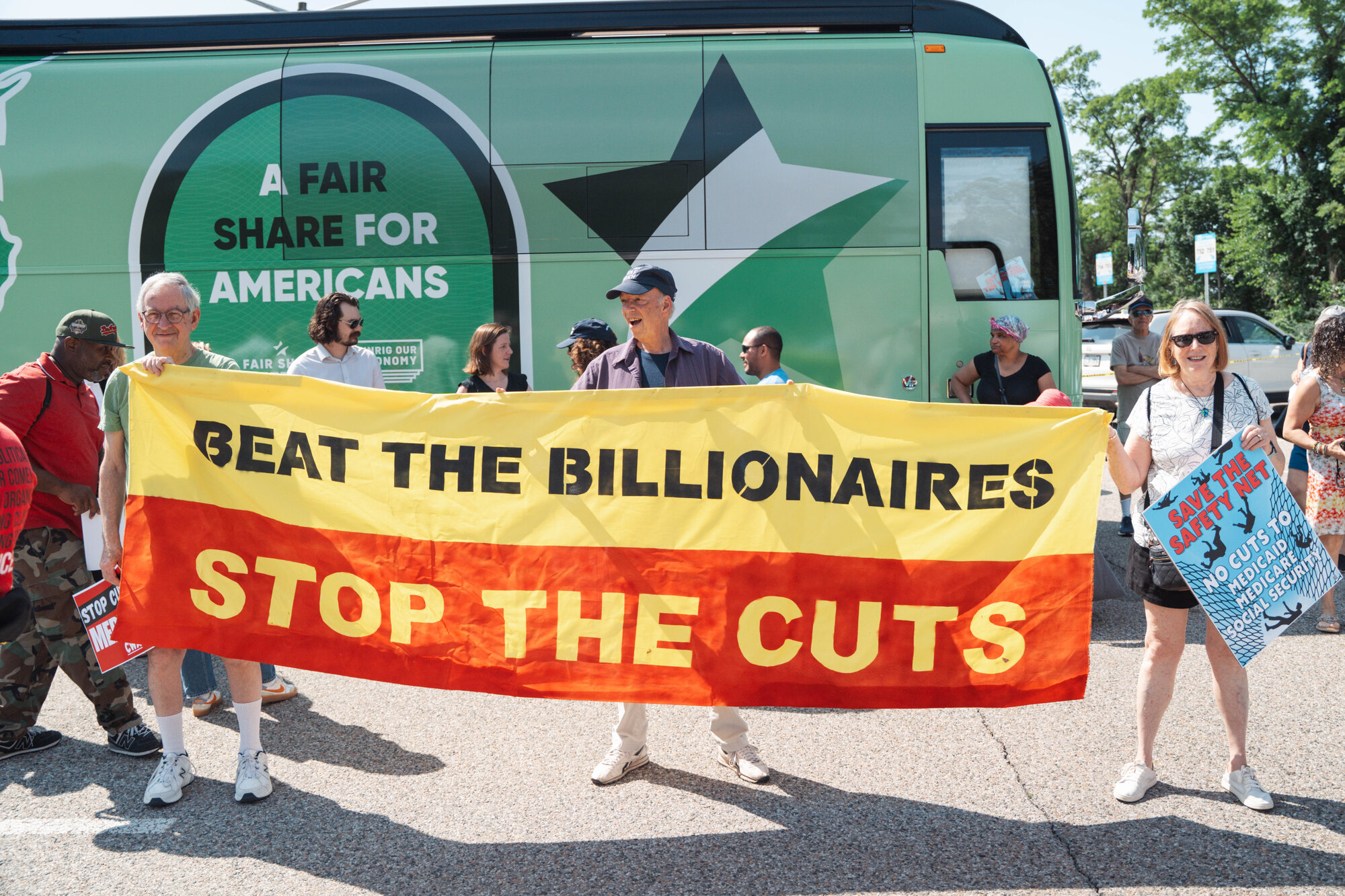
Southern Minnesotans, community leaders and elected officials detail devastating local impacts of OBBBA’s cuts, one year later.
MANKATO, Minn. (July 10, 2026) – One year after President Trump signed the One Big Beautiful Bill Act into law, Mankato area residents, parents, and elected leaders gathered Friday to describe the real-life consequences of the law that took from working families to pay for $4.5 trillion in tax cuts for billionaires and large corporations.
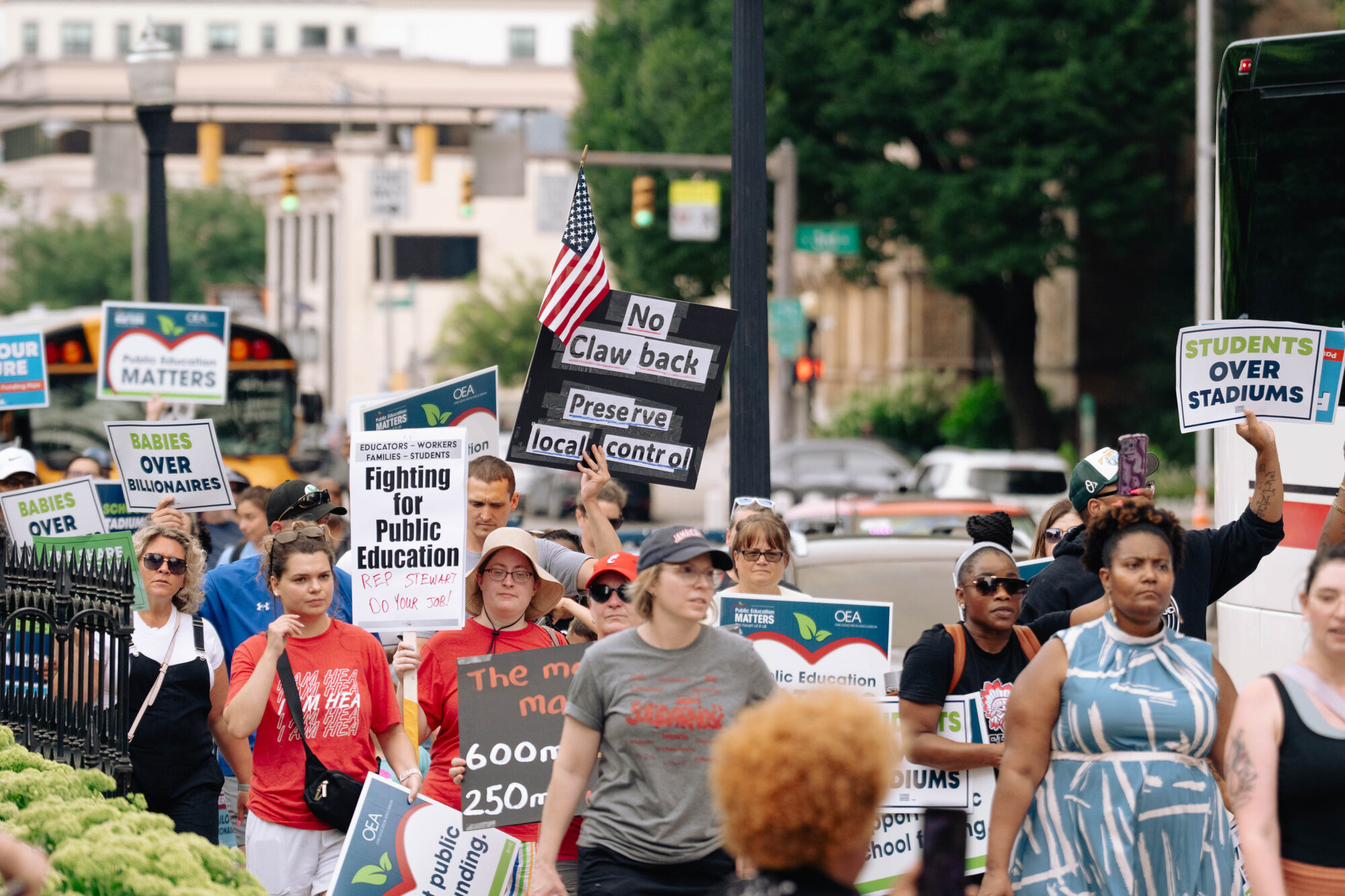
Families Over Billionaires, together with We Make Minnesota brought its nationwide Who Pays? Bus Tour to Mankato, where speakers warned that cuts to Medicaid and SNAP, higher health care costs, and growing pressure on Minnesota’s budget are already hurting families and local communities.
- More than 140,000 Minnesotans are expected to lose Medicaid coverage.
- More than 16,011 people have already lost SNAP benefits.
- The expiration of enhanced ACA premium tax credits has increased insurance premiums for thousands of Minnesota families.
- Minnesota’s taxpayers are now shouldering billions in additional costs shifted from the federal government.
Last summer, many of the same organizations rallied in Rochester urging Rep. Brad Finstad to oppose the bill. Friday’s event marked a return to the district one year later to assess the law’s impact—and to hold elected officials accountable for supporting it.
EXERPTS
Kristen Crowell, Executive Director of Families Over Billionaires talked about the movement that is building up in Minnesota and around the country as a result of harms from the OBBBA:
- “One year later, we’re here to start naming the names and holding folks accountable that it was so easy to throw our communities and our members under the bus in order to hand the billionaire class giveaways…. This is a moral failure. This is a policy failure, and this ultimately will be a political failure.
- “We are building a different kind of politics, one where we understand that regardless of where we live, we are interconnected. Our stories not only illustrate to the public what these horrible policy choices are doing, but how interdependent we are on each other in our community, with our neighbors and our families. What I’ve seen in the last few weeks as I’ve traveled coast to coast, is a resiliency and a resolve that no politician in Washington D.C. should underestimate.”
Leah Hanson, a social worker and Medicaid recipient shared how Medicaid has helped her and in turn allow her to help her community:
- “When I was 23 years old, I was paralyzed in a car accident, and it left me disabled for life. Medicaid became more than just my health insurance. It gives me access to my community, independence to participate, and to continue to build a meaningful life. Without it, my world would be very small. And today, I have the privilege of serving our community as a social worker.
- “When massive corporations and billionaires are allowed to avoid paying their fair share, working Minnesotans shouldn’t be expected to carry the burden. Yet that’s exactly what we’re seeing. The devastating cuts to Medicaid and SNAP, championed by President Trump and the Congressional GOP, send a clear message: protecting the wealth and profits of the powerful matters more than protecting the health and well-being of our neighbors. But it doesn’t have to be this way.
Chandra Petersen, a rehabilitation counselor and President of MAPE Local 1902 detailed how cuts impact her work helping people with disabilities find jobs in public service:
- “The stories of people I’ve shared with you today aren’t just statistics. It’s a dentist, a young man starting his first job, and a teacher inspiring the next generation, and thousands of Minnesotans working towards independence and dignity. Their success is Minnesota’s success.
- “As elected officials make decisions about the budget, we want them to choose care, choose fairness, and choose budgets, and choose the budgets that fund our lives. The solution is simple: make the pot bigger. It is time for the wealthiest Minnesotans and large corporations to pay their fair share, so we can fully fund the services that strengthen our communities. Because when we invest in the people, we all succeed, and that’s the Minnesota we should all be fighting for.
Rachel Bendickson, a home care worker and member of SEIU Healthcare Minnesota & Iowa, talked about the impact she’s feeling as she takes care of her disabled son at home:
- “We’re starting to already see the effects of the cuts to Medicaid. It recently actually prevented me from being able to my son to go see his specialty doctors in the cities, because it wouldn’t be safe for us to transport him by ourselves. Other effects that we see right now, is around $10,000 in costs added in just my personal budget.
- “It’s time that we actually fix these tax tax loops for the rich so that we can help our society’s most vulnerable people. If we can’t help society’s most vulnerable people, what is that saying about society? It’s not about a left or right issue. This is about right or wrong, and we need to start doing this right.”
Cindy Friesen, President AFSCME Local 638 and an executive assistant in academic affairs at Minnesota State University, Mankato called out how cuts always fall on working people:
- “For too long, we have seen the same broken pattern play out again and again. The wealthy and well-connected get tax breaks, tax cuts, sweetheart deals. Then, when it’s time to fund the services our communities rely on, we are always told there is not enough money. Not enough money for students, not enough money for departments, not enough money for workers who keep our campuses and communities running. Not enough money for the public services that working people depend on every single day. That is not an accident. That is a very clear choice of those who defend the mediocre status quo. And when lawmakers choose not to rise to the revenue we need, the costs do not disappear. We just get pushed onto workers, onto students, onto families, and onto our neighbors.”
State Representative Luke Frederick closed out the remarks by talking about how irresponsible the OBBBA cuts are and how they’re impacting Minnesotans:
- “Congressman Finstead is on record talking about what he referred to as the ‘Big Beautiful Bill.’ We’ve all heard that term — that there’s nothing wrong with it, according to him. Well, if people are looking for an alliteration, I would say this: it’s a Big Budget Bomb. It is the most fiscally irresponsible piece of legislation in our nation’s history.
- “In Blue Earth County alone, that’s a million-dollar reduction in SNAP benefits. That’s countless people wondering where their next meal is going to come from. So we have to be creative. We have to make sure that our tax code is fair and that people get the services that they deserve. That people can get the meals that they need to be part of the workforce. That people can get the education that they need to be our future leaders.
Mankato was the 12th stop on the 17-city Who Pays? Bus Tour, which began June 30th in Portland, Maine, and concludes July 16th in Tucson, Arizona. At each stop, local residents share how policies that favor billionaires and large corporations are affecting their communities.
Who Pays? bus tour national partners include: GenZ For Change, Protect Our Care, Committee to Protect Health Care, National Women’s Law Center, Institute on Taxation and Economic Policy, DemCast USA, National Nurses United, Oxfam, Unrig Our Economy, Americans for Tax Fairness and State Revenue Alliance.
Also see the latest op-ed from Kristen Crowell on Heartland Signal: “OP-ED: Billionaires got a break. The rest of us got the bill.”