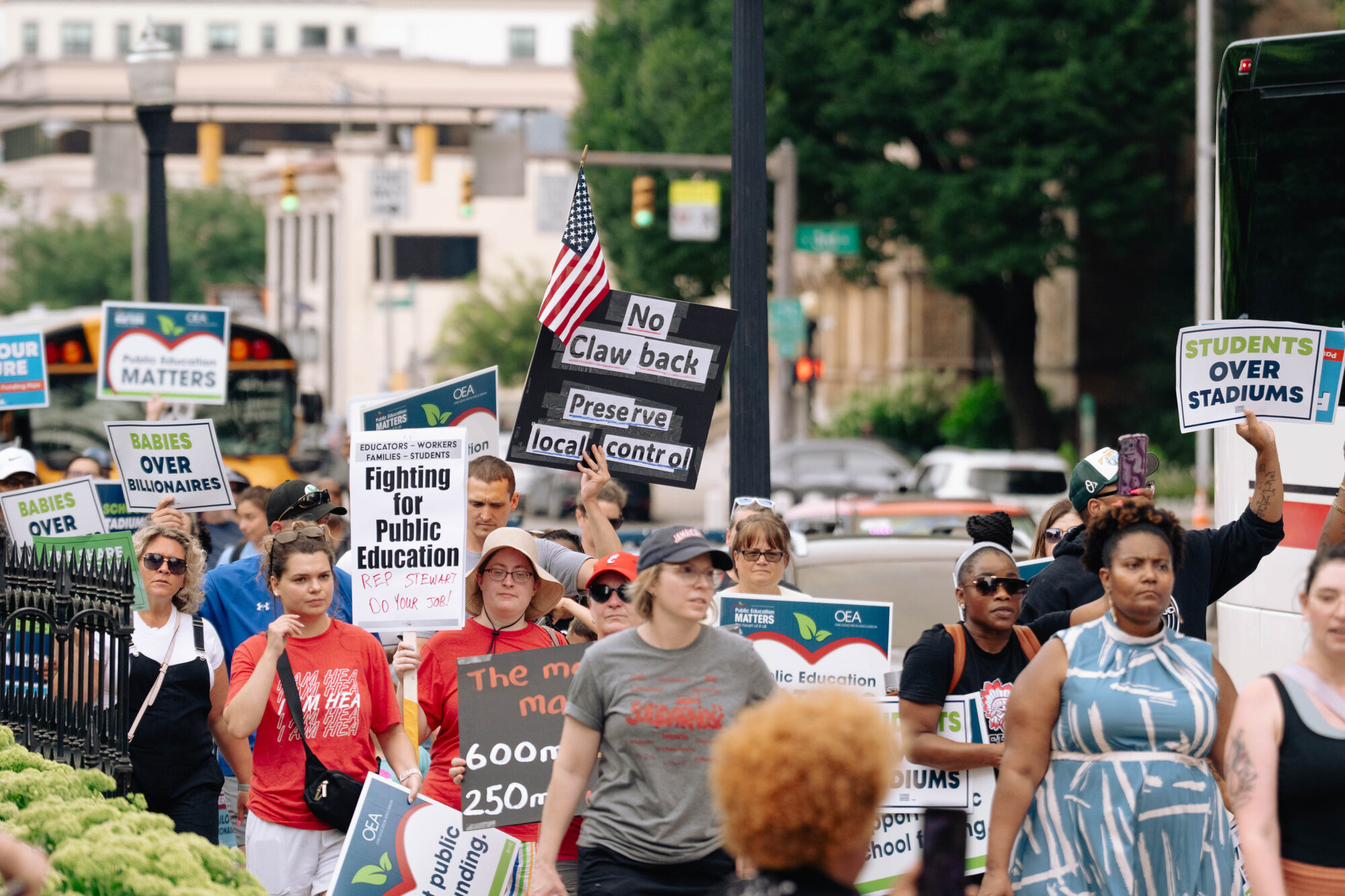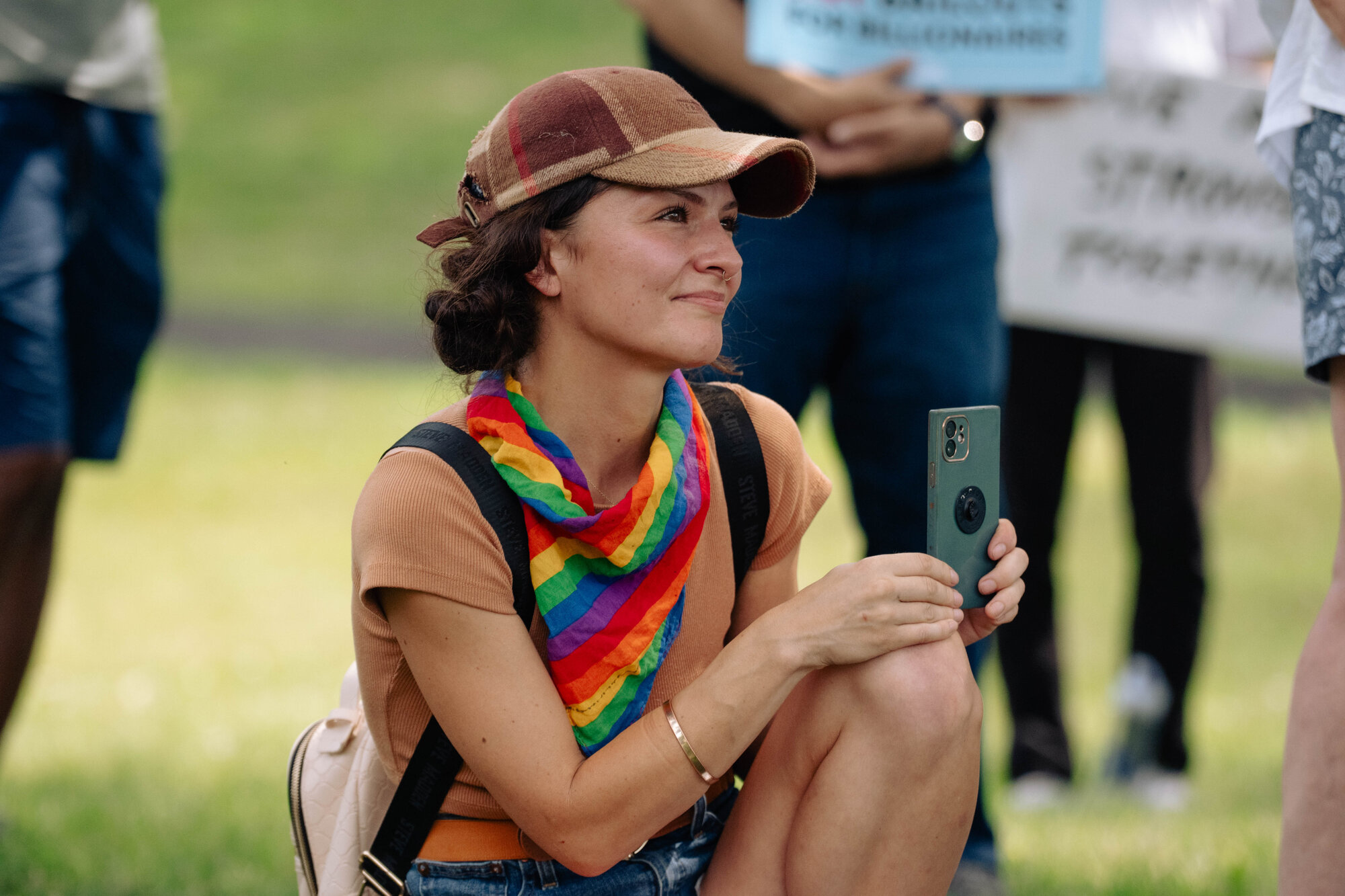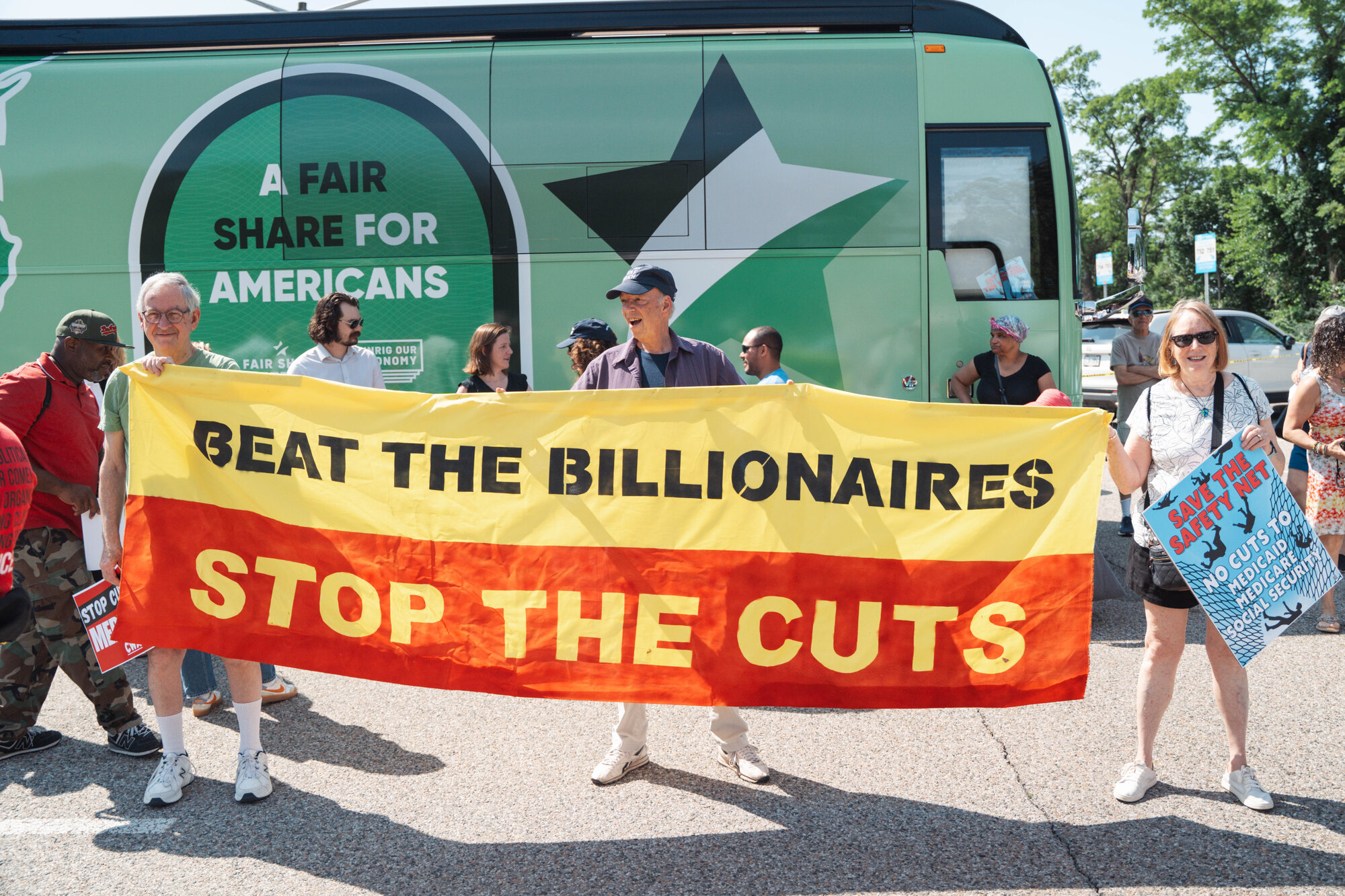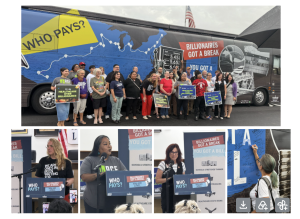
Community members and elected officials detailed devastating local impacts and called out Rep. Juan Ciscomani for gutting Medicaid and SNAP in the OBBBA one year ago.
TUCSON, Ariz. (July 16, 2026) – One year after President Trump signed the One Big Beautiful Bill Act into law, Tucson residents, parents, public servants, and elected leaders gathered Wednesday to describe the real-life consequences of the law that took from working families to pay for $4.5 trillion in tax cuts for billionaires and large corporations.
Families Over Billionaires, together with LUCHA, Arizona Center for Empowerment, IBEW Local 540, Opportunity Arizona and Oxfam, and state partners brought the Who Pays? Nationwide Bus Tour to Tucson for the final stop on the 17-city national campaign that began June 30th in Portland, Maine. Speakers discussed how cuts to Medicaid and SNAP, higher health care costs, and growing pressure on Arizona’s budget are already hurting families and local communities.
Arizona has been one of the hardest hit by OBBBA’s cuts to SNAP, seeing a 53% drop – aka 469,000 individuals who have lost their SNAP benefits from June 2025 to March 2026. That amounts to more than in Arizona already.
Additionally, as the rest of the OBBBA provisions take effect:
- More than 300,000 Arizonans are expected to lose Medicaid coverage.
- The expiration of enhanced ACA premium tax credits has increased insurance premiums for thousands of Arizona families, forcing 66,000 people to drop their health care.
- Arizona’s taxpayers are now shouldering billions in additional costs shifted from the federal government.
Last summer, many of the same organizations rallied in Tucson urging Rep. Juan Ciscomani to oppose the bill. Tuesday’s event marked a return to the district one year later to assess the law’s impact—and to hold elected officials accountable for supporting it.
EXERPTS
Kristen Crowell, Executive Director of Families Over Billionaires
- “It’s unconscionable that we live in the richest country in the history of the globe, and we are sentencing families to go without food-a very basic need.
- “We are not in these circumstances because we’re bad people, because we did something wrong. We are working all of the hours, filling out the paperwork. The system has failed us – it is failing us, and it will fail us until they understand who we are. Sharing our stories is our ability to claim our own power and to release the shame. The billionaire class thrives on us thinking that we are powerless, and they want us to turn on ourselves and each other. So tonight we’re here because storytelling is powerful.
- “We are charting a new course that is vibrant. It is rooted in our story. It is rooted in our place, and it is rooted in both care and compassion and deep, deep organizing. So it’s a privilege to be here tonight and to bear witness to the stories of Tucson and this part of the state. We’re sending a very clear message: we’re not going anywhere. We are not backing down from this fight.”
Rep. Nancy Gutierrez, AZ LD 18
- “The people of Southern Arizona are resilient. We come from rich cultures and hardworking families, but today our very health and safety is at risk and being tossed away because one year ago, Representative Juan Ciscomani did what he said he would not do, and he voted for that big ugly bill.
- “What does this mean for us in plain terms? It means a grandfather in Tucson, living with diabetes, suddenly finds his medication unaffordable, forcing him to ration that insulin. It means neighbors with a lifelong disability, someone who relies on Medicaid just to have the mobility to take a single step, is now left fighting a mountain of red tape just to get their care.
- “Because of these changes, we are already seeing neighbors delay critical care, waiting until they’re in absolute crisis before they go to the emergency room, and then they come out with astronomical bills that there is no way they can ever afford. And when those patients finally get to the hospital, what will they find? An empty concrete building with closed sign up because HR1 drains over $6 billion from Arizona’s medical network and more than half of our state’s hospitals are being pushed into the red.
Faith Ramon, ACE Organizing Manager
- “I come from the Tohono O’odham Nation, a community called Quijotoa, Arizona, and I know what it means when healthcare is not close by. When families already have to travel far for care, emergency services, hospitals, and clinics are not just buildings, but they are our lifelines.
- “The Arizona we deserve is not one where families are forced to choose between paying rent, buying groceries, seeing a doctor-it is not one where rural communities, tribal communities like mine, and working-class neighborhoods are threatened as disposables. It is not one where billionaires get tax breaks, while our hospitals, our healthcare workers, and our families are left fighting for scraps.
- “Working families are told there is not enough money for healthcare. There is not enough money for education. There is not enough money for housing, and not enough money for food assistance. That is a lie. Arizona is not broke. Our country is not broke. The problem is that billionaires are not paying what they owe, and politicians keep putting and protecting themselves instead of protecting us.”
Kara Manuel, Healthcare worker, COPE
- “We watch grant after grant disappear, and that’s funding for programs that help people to provide medication, to provide food distribution, and life skills training. Every time those resources diminish, people lose support that they rely on, and the progress they worked so hard starts to slip away.
- “I had one patient living with diabetes who couldn’t afford the supplies to help check his blood sugars, so we helped them get those supplies. But after we faced more cuts, that program shut down. So he lost critical support that was life-changing for him. Policies that don’t prioritize ours are snatching aid directly out of our hands.
- “We’re here because leaders made a choice instead of protecting healthcare services that families depend on, they chose to protect tax breaks for millionaires and powerful corporations. Those choices have real consequences, and we’re paying the price.”
Kristi Frisky, Directed Impacted Community Member
- “The healthcare system feels harder and harder to do whatever we need to do, and it’s already difficult enough to afford rent or a mortgage or groceries and gas and anything else we might need just to be able to survive. But lawmakers want to make it so health care is even further out of our reach and cutting more and more of our resources.
- “I pay taxes like everyone else, and yet that money gets used to give tax breaks to billionaires rather than to any of us in the community. It shouldn’t be this way. It shouldn’t be this difficult. Parents should be able to take care of their kids and take them to the doctor without jumping through hoop after hoop. People living with chronic illnesses shouldn’t have to worry about whether they can afford the care they need. Our health care system should work for all families, regardless of how much or how little we make. Instead Congress chose to protect billionaires and major corporations while cutting the programs people rely on to stay healthy.
- “I have to pay my fair share in taxes, then billionaires should pay theirs too. Working families shouldn’t be the ones paying the price while the wealthiest people continue to get handouts.”
Who Pays? bus tour national partners include: Main Street Alliance, GenZ For Change, Protect Our Care, Committee to Protect Health Care, National Women’s Law Center, Institute on Taxation and Economic Policy, DemCast USA, National Nurses United, Oxfam, Unrig Our Economy, Americans for Tax Fairness and State Revenue Alliance.
Also see the latest op-ed from Kristen Crowell on Heartland Signal: “OP-ED: Billionaires got a break. The rest of us got the bill.”