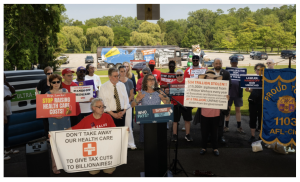
Families Over Billionaires’ “Who Pays?” report follows testimony from a national bus tour in 18 communities across 13 states.
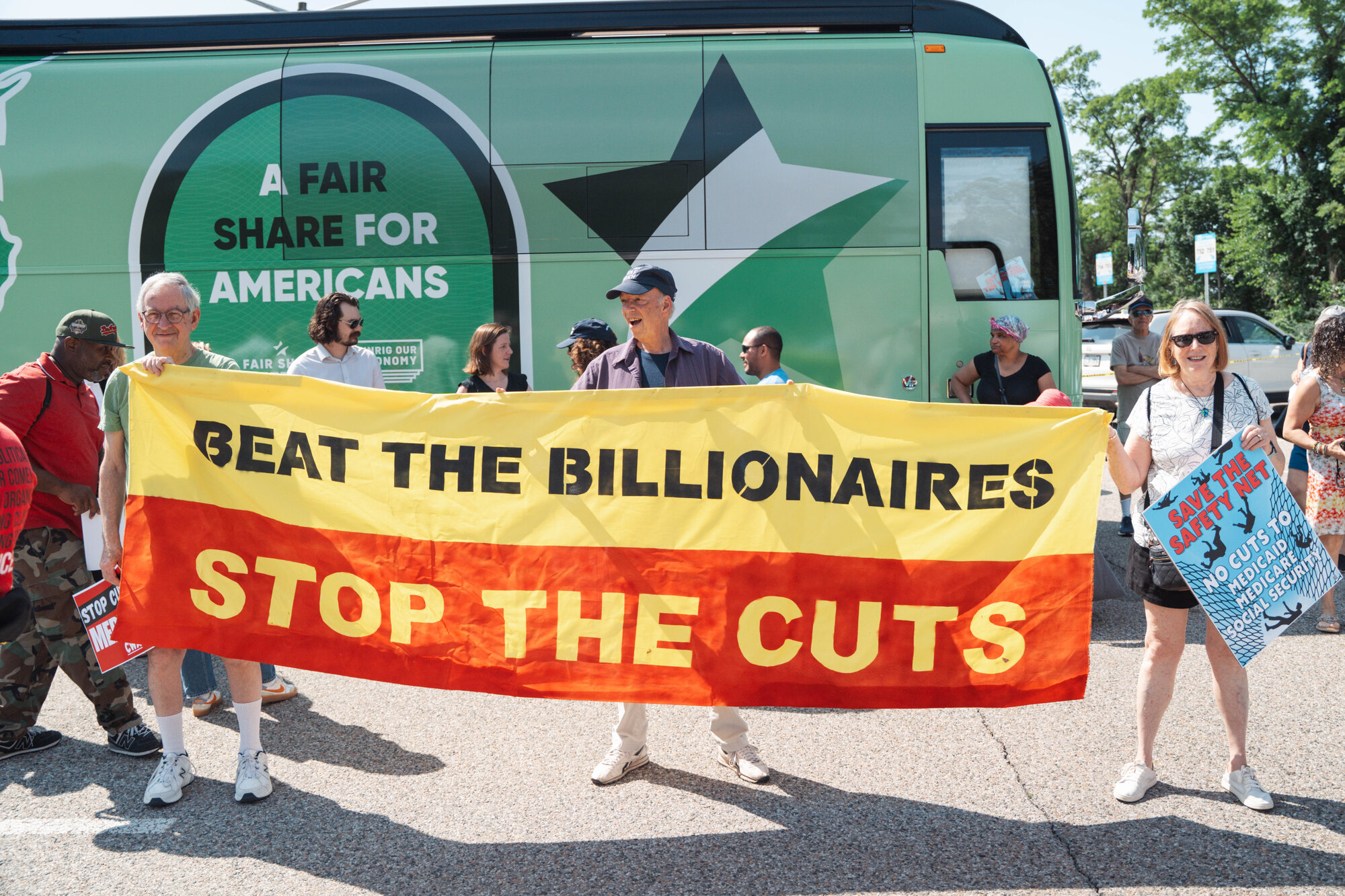
Chicago, IL — Today Families Over Billionaires released a new report documenting what the group heard on its summer bus tour across the country that started in Portland, Maine, and ended in Tucson, Arizona. Led by Kristen Crowell, the tour met with parents, nurses, farmers, educators, small business owners, food bank volunteers, health care workers, local officials, members of Congress, and thousands of Americans who rely on Medicaid and SNAP.
The report’s key finding is that the law’s spending cuts shifted the cost of vital services like food stamps and healthcare onto state budgets, struggling hospitals, underfinanced schools, strapped food banks, and families who are already hurting under the Trump economy. Meanwhile the law’s tax benefits flowed directly into the bank accounts of wealthy households and corporations.
“Ask anyone in the Trump administration and they’ll tell you this law is their signature economic achievement,” said Kristen Crowell, Executive Director of Families Over Billionaires. “Step one foot outside the Washington bubble and you learn fast what it actually is: a wealth transfer from American communities to billionaires’ pockets. We went to 18 communities in 13 states, and in every one of them we found the bill for that transfer: hospitals cutting services, food banks running bare, state budgets buckling, and families who did everything right falling behind.”
The report testimony paints a devastating picture of the damage wrought by the GOP’s signature legislation.
“When I was 23 years old, I was paralyzed in a car accident, and it left me disabled for life,” said Leah Hanson, a Medicaid recipient in Mankato, Minnesota. “Medicaid became more than just my health insurance. It gives me access to my community, independence to participate, and to continue to build a meaningful life. Without it, my world would be very small.”
Small business owners described the same squeeze.
“This is the first time since we opened three years ago that our bakery hasn’t been able to support our family of four,” said Sarah Burns, owner of Omega Bakery in Holmen, Wisconsin.
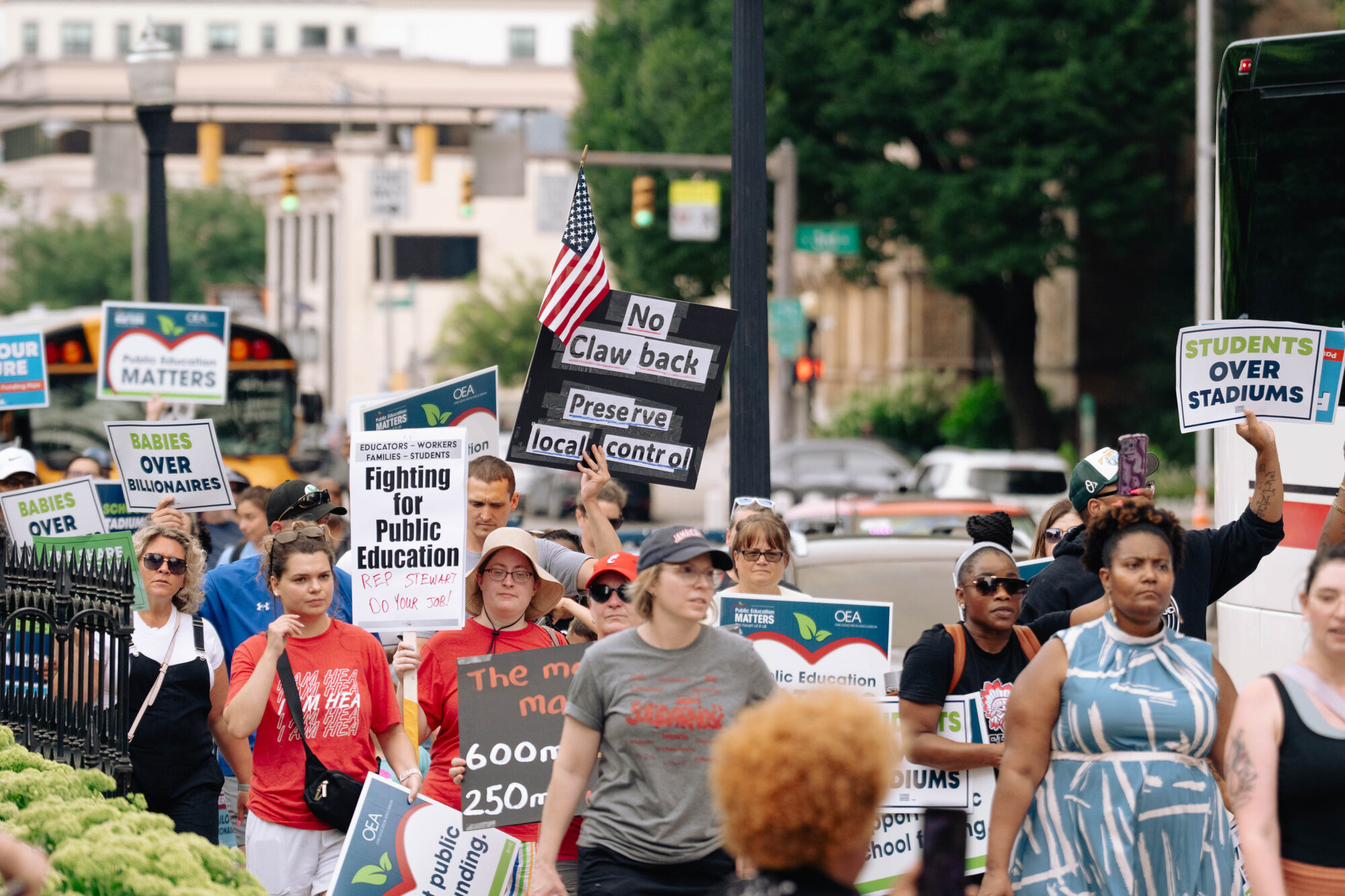
More than half its stops included direct community support, including food distribution and a $10,000 donation to the Food Bank for the Heartland in Omaha. In Racine, Wisconsin, hundreds of residents questioned Representatives Gwen Moore, Mark Pocan, Jim McGovern, Pramila Jayapal, and Delia Ramirez at a town hall on the law’s consequences.
Key findings include:
- States face massive new costs. Pennsylvania faces an estimated $53 billion cut in federal Medicaid funding and $2.1 billion in new SNAP costs over the next decade. Illinois faces $48 billion and $2.2 billion; Arizona $35 billion and $1 billion; Michigan $33 billion and $1.52 billion. Maine and New Hampshire each face roughly $3 billion in Medicaid reductions.
- Millions are losing health care. More than 14 million people are expected to lose health insurance. Medicaid cuts that took effect in January 2026 are pushing struggling hospitals, especially rural ones, to close maternity wards and clinics or shut down entirely.
- Food assistance is collapsing fastest in Arizona. SNAP participation in Arizona fell 53 percent between June 2025 and March 2026, stripping more than 469,000 people of food benefits in a matter of months. Food banks and mutual aid networks report need far beyond what they can meet.
- Jobs are at risk. Cuts to Medicaid, SNAP, and clean energy programs could put more than 125,000 jobs at risk in New York, 56,000 in Arizona, 53,000 in Illinois, 52,000 in Pennsylvania, and 50,000 in Michigan.
- Voters feel the harm. One in three Americans say the law has hurt their personal finances, while only 8 percent report a major benefit, according to July 2026 POLITICO/Public First polling. Separate polling finds 86 percent of voters believe wealthy people have too much power over government, and 81 percent say requiring the wealthy to pay their fair share in taxes is essential to a strong democracy.
The full report is available here.