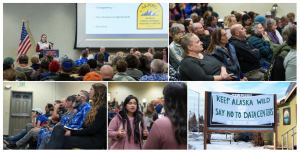
Fairbanks town hall brings together residents, veterans, and environmental advocates warning of corporate giveaways, higher energy costs, environmental threats, and a lack of public input
WATCH: “Nobody Asked Us” Alaska Town Hall
FAIRBANKS, Alaska — Alaska residents, veterans, and community advocates gathered last Thursday evening (October 29th) for “Nobody Asked Us: A Town Hall About Data Centers, AI, and Our Tax Dollars,” raising concerns about proposals to build massive AI data centers across the state and demanding answers about who stands to benefit — and who will be left paying the bill.
The event, organized by the Northern Alaska Environmental Center, Alaska Public Interest Research Group, Alaska Community Action on Toxics (ACAT), The Alaska Center Education Fund, Alaskans for Data Center Accountability, Native Moment, with the support of Families Over Billionaires, examined proposed data center developments on military bases, public lands, and marine sites across Alaska.
Speakers warned that these facilities would consume enormous amounts of electricity and water, strain local infrastructure, threaten sensitive ecosystems and public health, and leave communities with higher costs and few permanent jobs.
“The thought of listening to the endless drone of a for-profit AI data center that’s owned by billionaires who don’t live here shows we have completely lost our way,” said Sarah Hollister, Interior Regional Leader for Alaskans for Data Center Accountability and a lifelong Fairbanks resident. “We need to demand our lawmakers put people before profits. Alaska is not a business to be bought and sold to the richest billionaire.”
Speakers voiced concerns about proposed developments across the state:
Fairbanks, North Pole, and Eielson Air Force Base: Sarah Hollister (Alaskans for Data Center Accountability)detailed five potential data center sites near homes, schools, farms, and military housing, raising concerns about electricity costs, permafrost, air quality, groundwater contamination, and noise. She warned that private developments on military land would not generate local property tax revenue.
North Slope: Purruq Erica Khan, with the organization, Native Movement, discussed a proposed 715-acre development by Stack Energy and its potential impact on fragile tundra, wildlife, and subsistence resources. “The Arctic is not a wasteland. It is not a wasteland. It is a sanctuary. It is a university. It is a pharmacy,” Khan said.
Caroline Arnold with Alaskans for Data Center Accountability, described controversial proposals involving tens of thousands of acres of public land, including a proposed 20,000-acre transfer to the Alaska Industrial Development and Export Authority (AIDEA) for potential industrial development. She highlighted opposition from local officials and Houston’s adoption of a temporary moratorium on hyperscale data centers.
Arnold also raised concerns about a proposed underwater data center at Cook Inlet that could threaten endangered beluga whales, salmon fisheries, and marine ecosystems through noise, waste heat, and potential contamination.
Sara Thomas, an environmental justice organizer at Alaska Community Action on Toxics and mom of six, warned about potential PFAS contamination from data center cooling systems and questioned how developers could possibly manage chemical waste in a state already grappling with widespread contamination from military bases.
Speakers repeatedly questioned why public land and resources should be made available for private AI development without clear protections for taxpayers, electricity ratepayers, and surrounding communities.
“The people who live with the consequences of these decisions deserve a voice in making them, and the public should not be asked to accept the risks of these projects while being denied the information needed to evaluate those risks,” said Gratia Rowell, Energy Policy Analyst at the Alaska Public Interest Research Group (AKPIRG).
Rowell called for public disclosure of project agreements, electricity and water requirements, and infrastructure costs, along with limits on nondisclosure agreements and temporary moratoria to allow communities to evaluate proposals before decisions are made.
Connor Odom, a disabled U.S. Navy veteran, questioned why the military was pursuing private data center development on installations already dealing with environmental contamination and other infrastructure problems. “I feel like nobody asked us, and we certainly didn’t ask them to do this. So maybe they shouldn’t,” Odom said.
Maura Quint, partnerships director at Families Over Billionaires, connected the Alaska proposals to a broader national pattern of wealthy corporations seeking public subsidies and tax breaks while shifting costs onto working families.
“For decades, the rich and big corporations have pushed for more and more tax breaks for themselves, while the rest of us end up paying the price, and that is what we are fighting,” Quint said. She praised Alaskans for organizing across political divides to protect their communities, adding, “Billionaires should not be in charge of your future. You and your fellow Alaskans are the ones who should.” (Watch a clip here.)
The event also featured Krystal Lapp, Interim Executive Director of the Northern Alaska Environmental Center, who emphasized the importance of community organizing and public accountability. Organizers committed to compiling attendees’ questions and comments, submitting them to the appropriate state and federal agencies, and making any responses publicly available.
The Fairbanks event followed a town hall in Kirkwood, Missouri, where residents questioned why taxpayers are being asked to subsidize AI infrastructure while communities face mounting costs and pressure on public services.
Families Over Billionaires is calling on elected officials to oppose federal tax loopholes and incentives that subsidize massive AI data center development, roll back existing corporate handouts, and ensure communities have a meaningful say before any projects move forward.